
A legacy of leadership, scholarship, and community in city and regional planning
By Karen Chapple, January 5, 2026
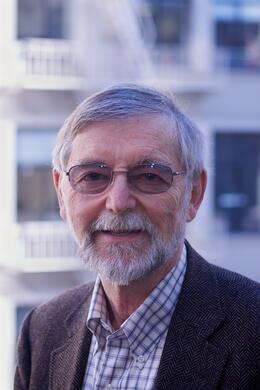
Michael B. “Mike” Teitz, Professor Emeritus of City and Regional Planning at the University of California, Berkeley, passed away peacefully at home on December 17, 2025, after a short illness. He was 90.
In a long and varied career, Teitz shaped his department at UC-Berkeley (serving as chair for five years), rejuvenated the Association of Collegiate Schools of Planning (serving as President), chaired the UC-Berkeley Academic Senate, and helped form the Public Policy Institute of California as a solidly nonpartisan policy research institute—among many other ventures. He was a self-described “institutionalist.” As he explained in a 2017 oral history conducted by the Bancroft Library at the University of California, Berkeley:
“Our institutions are not there by accident; we make them.”
Teitz’s successes, especially as an institution-builder, drew on his incisive intellect, clarity of communication, sense of humor, and unfailing civility and kindness. With his enduring respect for and curiosity about people, Teitz attracted countless students, collaborators, and friends into his extensive and dedicated social network. He treasured not just this community, but the very notion of community as central to the field of city planning and its quest for a better way for people to live. Nonetheless, he held a deep and abiding conviction that a nonideological, analytical approach needed to coexist with community and idealism to plan efficiently and equitably.
His most impactful intellectual contributions helped legitimize planning as a science. Two early papers, “Heuristic methods for estimating the generalized vertex median of a weighted graph” (Teitz and Bart 1968, in Operations Research) and “Toward a theory of urban public facility location” (Teitz 1968, in Papers in Regional Science) addressed problems in location theory. The heuristic methods piece has been referenced nearly 1,300 times across many different disciplines, including operations research, geography, transportation, regional science, business, applied math, and computer science, and continues to garner dozens of citations each year. Though critiqued by the radical Marxist geographers of the time, the piece addressed social equity via rational planning, advancing a theory of how facility location could serve the entire population most efficiently, rather than simply maximizing profit.
Born to a working-class family in East London in 1935, Teitz’s early years were shaped by World War II. He spent five years of his early childhood evacuated to a farm in the town of Thorley (Hertfordshire) while his parents continued working in nearby cities. Channeled into an economics track in high school, he transitioned easily into the London School of Economics. A small notice on a bulletin board there inspired him to apply for a Fulbright at the University of Wisconsin, Madison, in Geography for his Master of Science; subsequently, Walter Isard offered to support his Ph.D. in regional science at the University of Pennsylvania. In 1964, Teitz received one of the first PhDs in that discipline. Meanwhile, a phone call from Mel Webber, Chair of the Department of City and Regional Planning (DCRP) at UC-Berkeley had brought him to California in 1963, where he remained for the rest of his career.
At DCRP, Teitz soon assumed the role of anchor and peacemaker across a diverse set of faculty and students. As he noted in his oral history, “I was seen as kind of a center of stability in the department, of somewhat more rational thinking in a realm where people tend – among faculties as they do – to get very worked up over very small things.” For Teitz, some of his most meaningful accomplishments as Chair were bringing the first women into the department after the untimely death of Catherine Bauer Wurster and enabling many more female and minority faculty hires.
Teitz helped to reorganize the curriculum into a tripartite structure – physical planning, systems, and policy – with a common core of theory and methods. His scheme eventually evolved into the concentrations that are now prominent in planning pedagogy across North America today. He built a variety of quantitative methods into the curriculum, perhaps most notably the regional compendium, a thick description of regional economies. Working closely with students, he also introduced the first local economic development course. Along the way, Teitz taught most of the courses in the department, concluding with planning history.
Teitz served on more PhD dissertation committees than any other faculty member in the department: over 90 in his career. As UC-Berkeley’s DCRP has long produced more faculty for academic planning programs than any other department, Teitz had arguably the greatest influence on planning education of any educator to date. Teitz’s penchant for welcoming new, stuck, or orphaned students was seemingly limitless; though after the rescue, the “tough love” regime often began. Still, Teitz was incredibly proud of the accomplishments of his students – as well as those of his wife, UC-Berkeley Department of Architecture Professor Emerita Mary Comerio, and two daughters – and promoted their work far and wide.
Late in the 1970s, Teitz became active in the Association of Collegiate Schools of Planning (ACSP). The planning academy had long been subsumed to planning practice within the American Institute of Planners. Working with colleagues from across the US, Teitz engineered the establishment of ACSP as an independent institution and instituted the annual meetings. Teitz served as ACSP president from 1981 to 1983, won the Distinguished Educator Award in 1998, and attended the annual conference until 2020. His involvement with the academy continued until 2024 through his frequent book reviews for the Journal of the American Planning Association; one of his last reviews was co-authored with daughter Catherine, much to his delight.
Active also in UC-Berkeley administrative committees, Teitz was appointed Chair of the Academic Senate in 1992-1993. He spent most of his term contending with what was then UC-Berkeley’s greatest financial crisis to date. His contributions to campus and DCRP earned him the Berkeley Citation upon his retirement from UC-Berkeley in 1998.
Long consulting stints, first working with the Rand Corporation in New York on rent stabilization and then in Saudi Arabia, kept Teitz engaged in applied policy and planning practice. At home in Berkeley, Teitz co-founded Berkeley Planning Associates (with DCRP colleague Fred Collignon) and played an active role in it for almost two decades.
In 1995, his former student David Lyon (DCRP PhD, ’72) recruited Teitz part-time (and soon full-time) to the new Public Policy Institute of California (PPIC) to develop its strategic plan. As the inaugural research director, Teitz developed a broad initial program with research on demography, inequality, social policy, education, and public finance, among other areas. Key to PPIC’s early success was Teitz’s ability to identify and recruit exceptional talent. Meanwhile, he was able to continue his own regional research interests with studies on land use modeling in the Central Valley, California Environmental Quality Act reform, and regional planning.
In 2004, Teitz stepped down from his leadership role at PPIC but remained active as an Adjunct Senior Fellow. In the early 2000s, he advised the founding administration of UC Merced in the creation of an integrated science and humanities undergraduate program. He served on the board of the San Francisco Bay Area Planning and Urban Research Association from 2008-2016 and continued advising other state and local planning organizations (as well as former students) informally well into the 2020s. He sat on his last PhD orals committee for DCRP in 2019.
Although deeply enamored with California, Teitz remained a British citizen and visited his family and friends in the UK yearly until late in life. His speech retained many Britishisms but with a California twist, peppered with idioms like “far out.” An opportunity to write about his cherished California to a British audience came in 1996, with a bi-monthly column for Town and Country Planning. Columns monitored the pulse of US and Californian planning as it grappled with urban sprawl and growth management, environmental justice and protection, backlash against planning, and recurring swings between prosperity and crisis. At the time of his death, he was writing a column on the California Forever new city project.
Teitz’s life and work touched an extraordinary number of people and institutions. Perhaps his motto, as he frequently exhorted people, was “Carry on.” In his oral history, he reflected: “When the world is deeply uncertain, you take nothing for granted. On the other hand, the present is always there, and you act within it, and you deal with it as it comes. I didn’t have a life plan, if you like.”
Mike is survived by his beloved family: his wife Mary Comerio, daughters Alexandra Teitz (with her partner Craig Brooks) and Catherine Teitz, granddaughter Cecily Brooks, and many nieces and nephews. He was preceded in death by his siblings, Betty, Mil, David, and Gil, all of the United Kingdom.
A memorial will be planned for the weekend of 28-29 March, 2026 at UC-Berkeley. Date and event details to follow on the CED website.
A memorial service is being planned by the family for Saturday, March 28, at 2 p.m. in the Bauer Wurster Hall auditorium (room 112). In lieu of flowers, donations can be made in Mike’s memory to the Mechanics’ Institute Library of San Francisco or The Michael B. Teitz Fellowship Fund at UC Berkeley. For the latter, please make checks payable to the UC Berkeley Foundation and send to UC Berkeley Gift Services at 1995 University Avenue, Suite 400, Berkeley, CA 94704-1070. Include “IMO Mike Teitz, FW5403000” in the check memo line.